
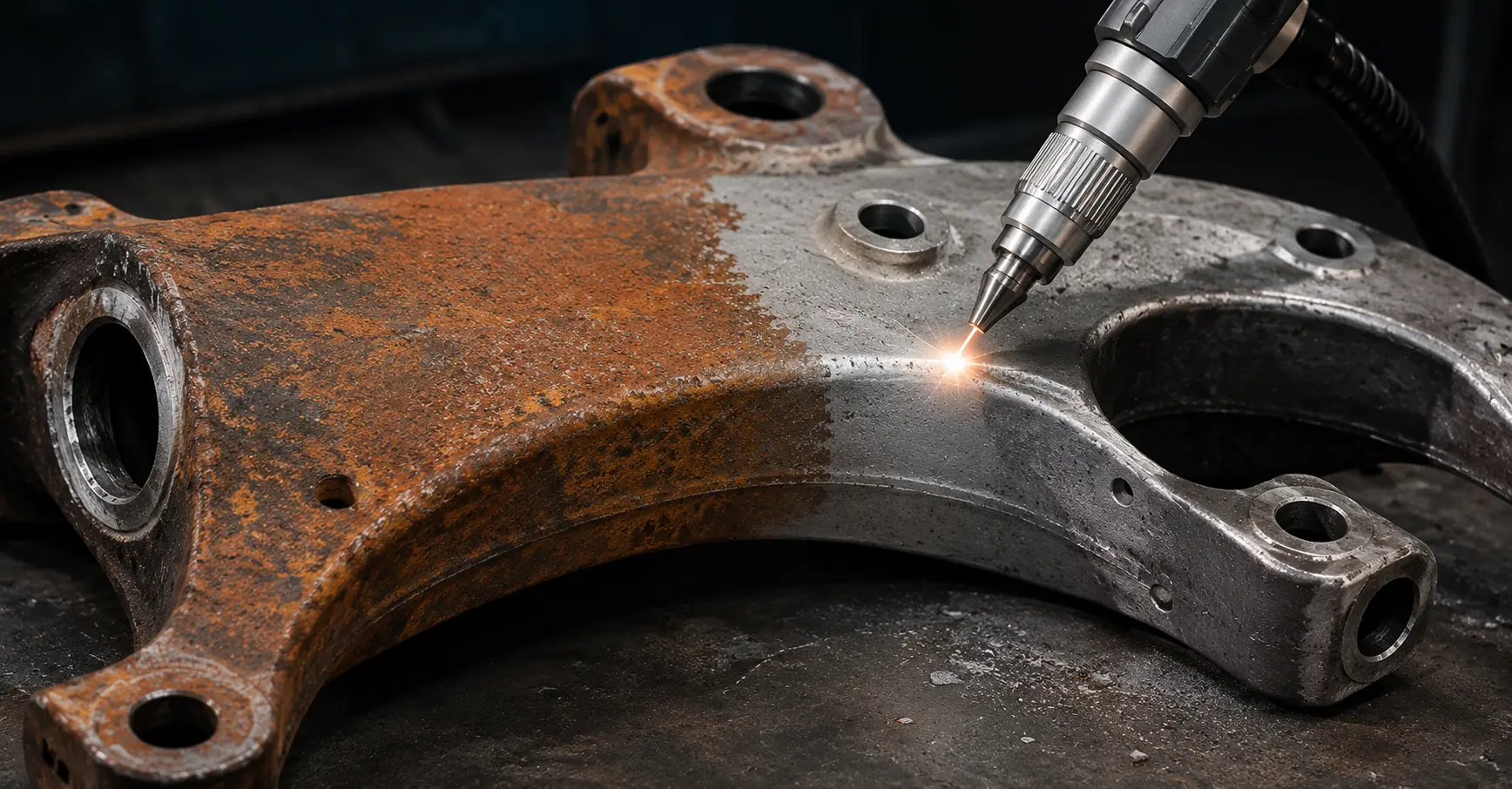
It is the first question most people ask, and it is the right one. You have a part worth saving, the rust needs to come off, and every method you know of takes some of the metal with it. So: can a laser get the rust off and leave the steel alone?
Short answer, yes. Here is why, and where the limits are.
How laser rust removal works
Rust is iron oxide, and it sits on top of the steel rather than being part of it. A pulsed fiber laser sends very short, very intense bursts of light at the surface. The oxide absorbs that energy, heats instantly and lifts off as dust, which goes into an extractor.
Clean steel behaves differently. It reflects most of that same light rather than absorbing it. So once the oxide is gone, there is far less for the beam to act on and the process effectively runs out of things to remove.
Nothing physically touches the part at any point. There is no grit, no wire wheel, no pressure and no chemical.
Why it does not grind away the base metal
Every abrasive method works by impact. Blast media, flap discs and wire wheels all take material off, because that is how they remove the rust in the first place. They cannot tell the difference between oxide and steel; they simply remove whatever is in front of them until you stop.
A laser is selective by nature. The difference between how oxide and bare metal respond to the beam is what does the work. Set correctly, it takes the layer you want and leaves what is underneath.
In practice that means the panel keeps its thickness, edges stay sharp, stamped detail stays crisp, machined faces stay flat, and casting marks and tooling marks survive.
Surface rust versus heavy rust and scale
Light surface rust is the easy case. It comes off quickly and cleanly.
Heavy rust, thick flaking scale and mill scale are a different matter. There is simply more material to remove, so it takes longer, and time is what the job costs. That is why heavy contamination is quoted by the hour rather than by the square foot.
This is worth knowing before you ask for a price. Two parts of the same size can be very different jobs.
What happens when the metal is already pitted
This is the part people are most often surprised by, so it is worth being clear.
Rust does not sit politely on the surface forever. Given time it eats into the steel, and once metal is gone it is gone. What is left is a pit, and the rust sitting in and around it has been hiding how deep it goes.
A laser removes the oxide out of those pits and leaves them clean. It cannot fill them, because there is nothing to fill them with. Nothing can, short of welding or filler.
So a heavily pitted panel will come back clean and pitted. That is not damage caused by the cleaning. It is damage that was already there, now visible. In fact this is genuinely useful: you can see exactly what you are dealing with before deciding whether the piece is worth restoring, which is much better than finding out after paint.
Thin sheet metal and automotive panels
Thin panels are where abrasive methods cause the most trouble. Blasting puts heat and stress into sheet metal and can leave it warped or oil-canned, and it thins the panel while it works.
Laser cleaning does neither. There is no mechanical force on the panel and no material loss, which makes it well suited to bodywork, fenders, tanks and any thin-gauge steel where a warp would be a serious problem.
Cast iron and heavy equipment
At the other end, cast iron and heavy sections take the process well. Casting texture and any stamped numbers or marks come through intact, which matters on engine components, machinery castings and anything where identification marks are part of the value.
Preparing metal for welding, paint or restoration
Laser cleaning leaves a dry, bare surface with no residue, no grit trapped in seams or box sections, and nothing to wash off before the next step. For welding, it gives clean parent metal to work on. For coating, it gives a clean surface with no media left behind to cause problems later.
One thing to expect: cleaned steel comes back matte and grey, not bright and shiny. That is normal. It is also bare, which means it will begin to flash rust within hours if it is left exposed. Plan to prime or coat the part soon after it is cleaned rather than leaving it sitting.
Reflective metals behave differently
Aluminium, copper and brass reflect much more of the beam than steel does, which makes them slower and more demanding to clean. It can be done, but it is not the same job as steel and it is not priced the same way. Tell us what the material is when you ask.
When blasting is actually the better choice
Laser is a precision tool, not a fast one. On a large flat area under heavy coatings, blasting is quicker and cheaper by a wide margin. If your coating specification calls for a surface profile for adhesion, blasting is what that spec means, because laser cleaning produces a clean surface rather than a profiled one.
We would rather tell you that than take the work. There is more on this in laser cleaning or sandblasting.
What this suits
Classic car panels, frames and brackets. Farm equipment and implements. Trailer frames, hitches and hardware. Machinery, castings and engine components. Fabricated steel where the detail matters. Marine hardware, props and shafts.
The common thread is not the industry. It is that the shape of the part matters as much as getting it clean.
Find out about your piece
Send a photo of the part along with a rough size and we will come back with a real number, and an honest answer about whether laser is the right tool for it.
Call or text (506) 588-6216 or use the quote form.