
Fire and Smoke Damage: What a Laser Can and Cannot Fix
After a fire, the decisions come quickly and usually while everyone is still shaken. An adjuster is on the way, a restoration contractor is quoting, and somebody has to decide what gets cleaned, what gets replaced, and in what order. Laser cleaning has a real place in that work. It also has limits, and it is better to know both before anyone starts.
What soot actually is
Soot is unburnt carbon, and it is fine, greasy and acidic. It settles into everything porous, including brick, mortar joints, concrete and bare timber, and it does not simply wipe off. Left alone on masonry it keeps etching. On structural timber it hides the condition of the wood underneath, which is exactly what an engineer needs to see.
The layer sits on top of the material. That is the useful part.
What the laser does
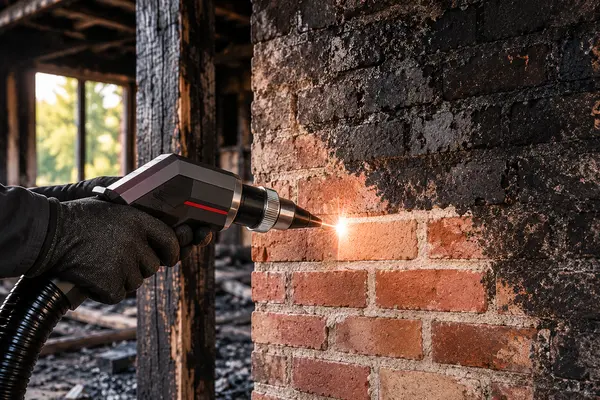
A pulsed fiber laser puts energy into that top layer. The soot and char absorb it and lift off as dust into an extractor. The brick, stone or timber underneath absorbs far less, so the beam stops there. The surface texture, the mortar lines and the grain of the wood come through unchanged.
That matters most on anything you are keeping rather than replacing. Exposed brick, a stone chimney breast, a foundation wall, old structural beams. The cleaning does not cut into the face of the material or round off its edges.
Why not a pressure washer
Pressure washing is the usual first instinct, and on a fire-damaged building it causes two problems.
It drives soot deeper into porous material instead of lifting it off. What looks clean while wet often greys back as it dries, because the staining has been pushed in rather than removed.
And it soaks a building that is already damaged. Water into a structure that has just been through a fire, and possibly through the fire service’s hoses as well, is the last thing anyone needs. Laser cleaning uses no water at all.
Why not chemical cleaners
Chemical soot removers work, but they mean fumes and runoff inside a building people have to go back into. There is product to store, to apply, to neutralise, and to dispose of. In an occupied or partly occupied structure that is a genuine complication.
The laser uses no chemicals. The debris goes into an extractor rather than onto the floor or down a drain.
What it will not do
It is not deodorising. Removing soot takes away a lot of what holds the smell, and in many cases the improvement is dramatic. But smoke odour trapped in insulation, drywall, carpet and soft furnishings is a separate remediation problem. That is a restoration contractor’s job, not a laser’s.
It is not structural repair. Timber that has lost section to charring may still need replacing, and that is an engineer’s call. What the laser does is clean it so the condition can actually be assessed. Nobody should be signing off on a beam they cannot see.
It does not bring back what the fire destroyed. Cleaning a surface is not the same as restoring it, and on badly damaged material replacement is sometimes the cheaper answer. We will say so.
Heritage and soft materials
Old lime mortar, soft brick and painted surfaces all behave differently. Every job of that kind starts with a test patch somewhere out of sight, with the machine dialled down until the result is right. Nobody should be guessing on a visible wall.
Working with insurance
Most fire work is insurance-funded, which means the paperwork matters as much as the result. We photograph the surface before and after and provide an itemised quote and invoice. That is normally what an adjuster needs to approve the work and close the file.
Getting a number
Send a photo of the affected area and a rough size. That is enough to price most jobs, usually the same day, and to tell you honestly whether laser is the right tool or whether something else would serve you better.
Call or text (506) 588-6216 or use the quote form.